
Colleton County Court Records After Arrest
After an arrest in Colleton County, two record tracks may exist at the same time. The Colleton County Detention Center record is a custody record. It can show the held-for agency, arrest date, warrant text, bond label, issuing county, and judge where that data is in the jail system. The court record is different. It is the case file that shows what was filed in Magistrate, Municipal, or General Sessions court after the arrest and first appearance. The formal prosecution track for serious criminal cases runs through the Fourteenth Circuit Solicitor's Office, which serves Beaufort, Colleton, Hampton, Jasper, and Allendale counties.
For custody and booking details, the county roster belongs on the Colleton County jail inmate records side of the search. Booking photos belong with the Colleton County jail mugshots record. Court records after a jail arrest answer a narrower question: what charge did the court receive, what status does the case show, and did the matter end in dismissal, plea, trial, sentence, or another disposition?
Find Colleton County Court Records
The official court-search route is the South Carolina Judicial Branch case-search system and the Colleton County Public Index. Start with the exact name from the jail roster, then compare arrest dates, warrant numbers, court agency, and charge wording. Serious criminal cases are usually General Sessions matters, while first appearance, traffic, some warrants, and lower-level cases may be handled by magistrate or municipal courts. If an online court entry is incomplete, the Colleton County Clerk of Court or the court named in the record is the better source for filings.
The Colleton Public Index screenshot in the manifest is tied to the official court search page.
The Colleton County Public Index is the court-side lookup for filed cases after an arrest.
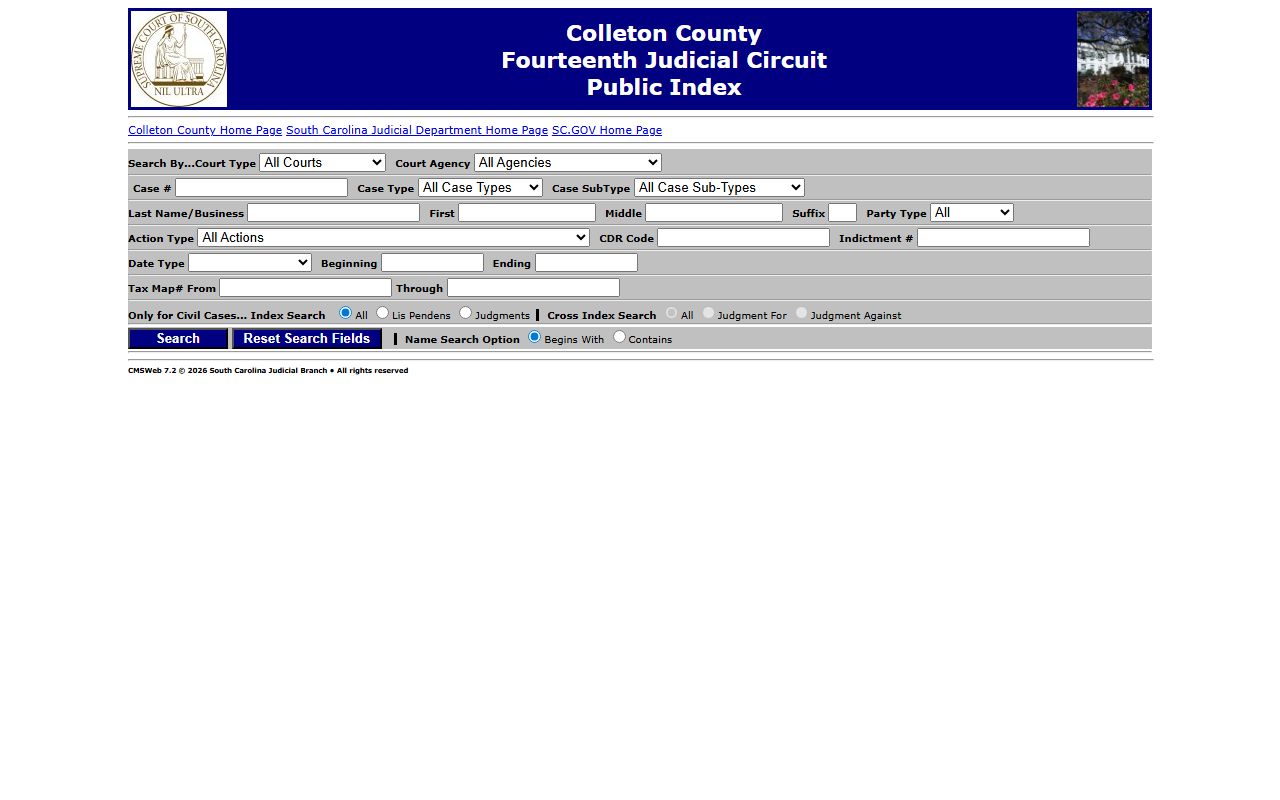
Use the Public Index result as the court record source, then use sheriff records only for booking, incident, custody, or jail documents.
- Check the jail roster first for the exact name, arrest date, held-for agency, warrant number, and bond text.
- Open the Colleton County Public Index and search by defendant name or case number if one is known.
- Compare court agency, charge wording, filed date, and warrant or case numbers before assuming a match.
- Open the case to review charge status, hearings, disposition, sentence, and financial obligations.
- For missing filings, contact the court clerk, magistrate court, municipal court, or sheriff records office based on the document sought.
Colleton Court Search Fields
The Public Index uses court-search fields rather than jail roster filters. A broad name search can return several people or several cases for the same person, so the best search uses more than one clue from the arrest record. The jail's hold reason may include a warrant number, judge, bond type, and issuing jurisdiction. Those fields help separate a new case from an older warrant, a family-court support hold, or an outside-agency detainer.
| Field Label | Type | Required | Options / Format Notes |
|---|---|---|---|
| Court Agency | Dropdown | Usually defaulted by county | Select the Colleton court or agency shown by the official index. |
| Case Number | Text | No | Use the exact case number when it is known. |
| Case Type | Dropdown | No | May narrow criminal, traffic, civil, or court-defined categories. |
| Last Name | Text | No | Useful as the first defendant search field. |
| First Name | Text | No | Use with last name to reduce false matches. |
| Middle Name | Text | No | Helpful for common names. |
| Date Filed | Date range | No | Use when the court filing date is known or can be estimated after arrest. |
Colleton Arrest Charging Documents
A booking charge is not always the same as the court charge. Colleton County Detention Center records may show an arrest warrant or hold reason because that is what caused custody. The prosecutor or court then controls the formal charging document. In South Carolina, serious criminal matters in General Sessions are prosecuted by the solicitor, and the case may proceed by indictment, information, plea, dismissal, or nolle prosequi. A complaint, information, and indictment all serve as charging paths, but they do not have the same source or use.
| Document Type | Who Uses It | What It Does | Search Note |
|---|---|---|---|
| Complaint or warrant | Officer, magistrate, or prosecutor | Starts or supports an accusation tied to an arrest or warrant. | May appear first in jail hold reasons or lower court records. |
| Information | Prosecutor | States formal charges without a grand-jury indictment where allowed. | Look for filed charge text in the court case. |
| Indictment | Grand jury and solicitor | Formal felony charging document for many General Sessions cases. | May appear after the initial arrest and bond stage. |
Colleton Charge Status Records
Charge status can change after a Colleton County arrest. A roster entry may show a felony arrest warrant, misdemeanor warrant, failure-to-pay warrant, or additional hold. Later, the court record may show a filed charge that is amended, reduced, dismissed, pled, or sentenced. The word "pending" means the case is still open. "Nolle prosequi" means the solicitor is not pursuing that charge at that time. A dismissal is not a conviction, and a conviction requires a guilty plea, verdict, or other judgment entered by the court.
| Status | What It Means | Why It Matters |
|---|---|---|
| Pending | The charge or case remains open. | Bond, hearings, or court dates may still control custody. |
| Amended or reduced | The original charge wording or level changed. | The court record may differ from the jail booking text. |
| Dismissed | The court ended the charge without conviction. | Expungement may be worth checking if eligibility exists. |
| Nolle prosequi | The solicitor declined to prosecute that charge. | It is a prosecutor action, not a jail action. |
| Convicted or pled | The charge ended with guilt by plea or judgment. | Sentencing, fines, probation, jail, or SCDC transfer may follow. |
Bond and Warrants After Arrest
Colleton bond information appears in the jail roster's hold reasons, not in a clean public bond table. Sample records showed Cash/Surety, No Bond, Other, and Additional Hold labels, sometimes with the judge or magistrate who set the amount. For current release questions, the jail phone line is the confirmation point. For court status, the Colleton County Public Index, magistrate court, municipal court, General Sessions, or solicitor record may control the next step. The sheriff homepage lists Warrants/Civil Process at 843-549-1964, and the detention center is reached at 843-549-5742.
A warrant can explain why a person is in jail even before a new court case is easy to find online. Arrest warrants, bench warrants, failure-to-pay warrants, and outside-agency holds may all appear as hold reasons. The Zuercher portal software contains warrant-search components, but a verified active Colleton public warrant list was not confirmed in the research. Do not rely on third-party warrant websites for a local legal decision.
| Bond or Hold Type | Plain Meaning | What to Verify |
|---|---|---|
| Cash/Surety | Release may be allowed by cash or surety terms. | Call the jail before posting or sending funds. |
| No Bond | Ordinary release is not available until further court action. | Check the court record and next hearing. |
| Other | The public roster does not show a standard cash amount. | Ask the jail or court what the label means in that case. |
| Additional Hold | Another court or agency may prevent release. | Confirm each hold, not just the Colleton charge. |
Charges Versus Convictions
The Colleton roster disclaimer says an arrest does not mean conviction and does not imply guilt or innocence. That warning fits the court-record search as well. A charge is an accusation or filed count. A conviction is the result of a plea, verdict, or judgment. A person can be arrested and booked, then have a charge amended, dismissed, declined, or resolved without the same wording that first appeared on the jail roster.
| Point of Comparison | Charge | Conviction |
|---|---|---|
| Stage | Accusation after arrest or filing. | Final or entered finding of guilt. |
| Source | Warrant, complaint, information, indictment, or court filing. | Plea, verdict, or court judgment. |
| Standard | Can begin with probable cause or prosecutor review. | Requires proof, plea, or judgment under court rules. |
| Public meaning | Shows the case allegation and status. | Shows the legal outcome for that count. |
Sealed and Expunged Records
South Carolina expungement law is separate from the jail roster and court search page. S.C. Code Sections 17-22-910 and following route many expungement applications through the solicitor's office in the circuit where the charge began. For Colleton County General Sessions matters, that points to the Fourteenth Circuit Solicitor. Expungement is the legal process used to remove qualifying arrest or charge records from public access. Sealing limits public visibility, while expungement is a deeper clearing process when the law allows it.
| Point of Comparison | Sealed | Expunged |
|---|---|---|
| Public view | Hidden or restricted from ordinary public access. | Removed under an expungement order when eligible. |
| How it happens | By court rule or order. | Through the statutory expungement process. |
| Colleton route | Ask the court that controls the record. | Start with the solicitor's required process for eligible charges. |
| Not automatic proof | A sealed record may still exist for limited users. | Eligibility depends on charge, outcome, and state law. |
Colleton Records Access Limits
South Carolina's Freedom of Information Act gives access to public records of public bodies unless an exemption applies. The Colleton County Sheriff's Office FOIA page sends requests to ccso-foia@colletoncounty.org, cites a 10-working-day availability determination rule, and posts fees for search, retrieval, redaction, and copies. Body-worn camera video is not treated as a public record subject to FOIA under the sheriff page. Juvenile information, active investigative material, informant identity, private data, and records that would require creating a new document may be restricted or denied.
Important: Public court and jail records may be incomplete, delayed, or restricted. Verify legal status with the court, clerk, jail, or solicitor before acting.